
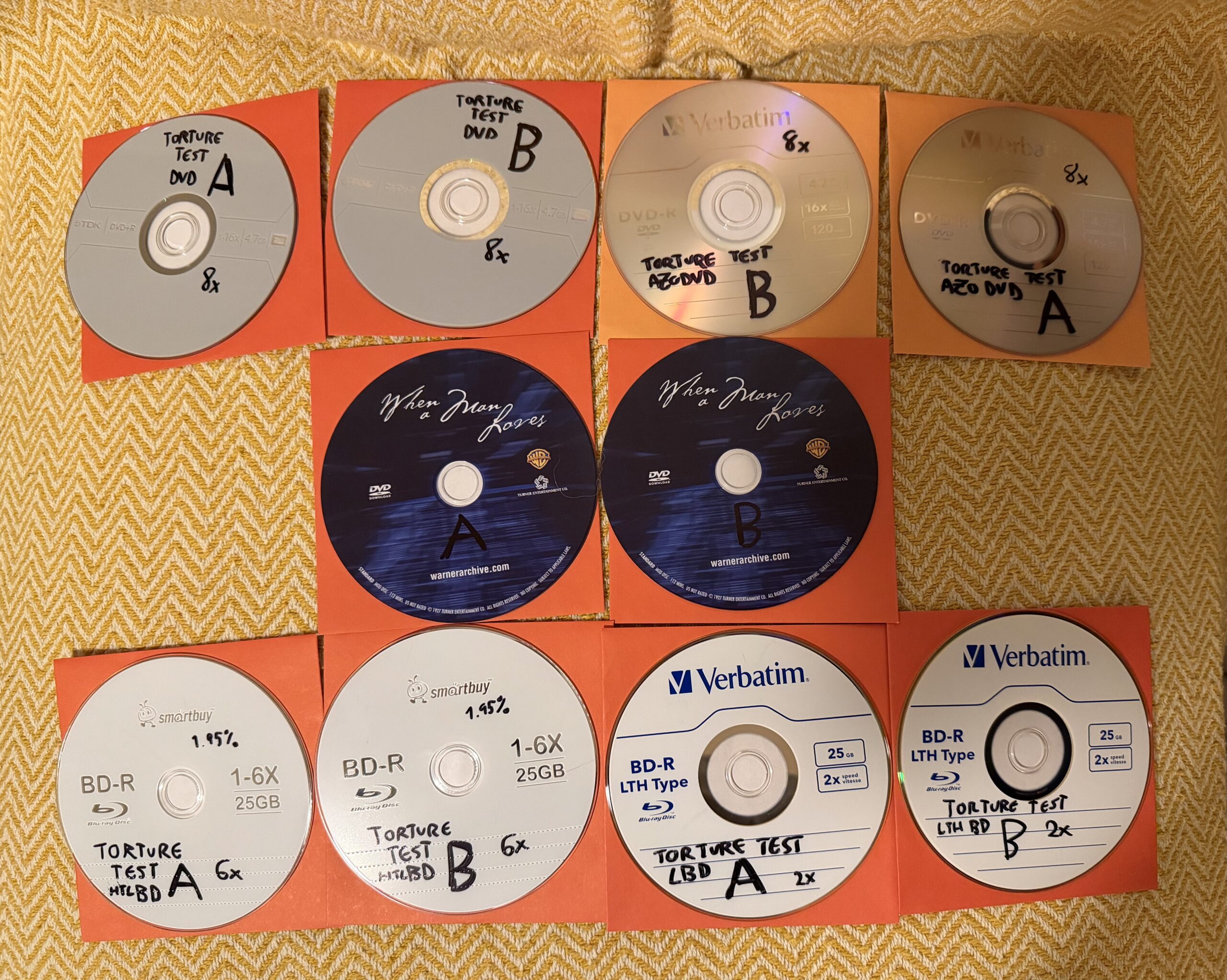
It’s common knowledge that burned optical media eventually fails, but there seems to be conflicting info online on what exactly leads to said failure. While I’m no scientist, I’ve prepared a test to hopefully answer some of these questions. To put it simply, I’m gonna leave a bunch of discs in my shed until they stop working.
I have prepared five pairs of discs, each representing a different type of burned DVD or BD that is commonly used for video or data storage. All discs are single-layer, and unless otherwise stated, were prepared using an HL-DT CA40N Blu-ray burner and the built-in macOS disc burning software at either 8x (DVD) or 6x (Blu-ray) speed. All discs were loaded with a text file of random characters, either 4.2GB or 22.3GB in size, burned, and were then checked in VSOInspector for any bad sectors, and their Redumper hashes recorded in a spreadsheet.
For the first set, I have a pair of TDK-branded cyanine-dye DVD+R discs (SKU #DVD+R47FCCB50*M), likely manufactured by Ritek. I believe these were purchased some time in 2008, and have been sitting in my basement ever since. Cyanine is generally considered to be one of the less reliable dyes used in brined discs, and with the discs almost 20 years old, I want these to serve as a worst-case scenario for the test. I would have preferred DVD-R discs for this set, both to match the other burned DVDs in this test, and due to their perceived worse longevity, but this is what I had lying around.
For the second set, I have a pair of Verbatim-made azo dye DVD-R discs (SKU #43729), purchased brand new on Amazon in August 2026, although I do not know when they were actually manufactured. Azo dye based discs are generally considered some of the most reliable DVDs you can get, so I wanted this to serve as a best case scenario for DVDs that are still being manufactured.
For the third set, I went with something slightly different: a pair of copies of When a Man Loves, the cheapest Warner Archive film on DVD-R currently available new on Amazon in August 2026. I’m unsure on the exact make, but visually they appear to be azo dye (which would imply Verbatim). I wanted this to serve as a best-possible case for any form of burned DVD, as reports of failures of Warner Archive discs are incredibly rare, and if any discs would survive this test, it would be the ones “professionally” burned. Unfortunately, I discovered a ring scratch on disc A, and I’m unsure if that occurred in the factory, or inside my DVD drive. While not planned, this could serve as an internet contrast to the unscratched discs, as they may age differently.
For the fourth set, I have a pair of SmartBuy-branded HTL BD-Rs (SKU #8541706857) manufactured by Ritek and purchased in November 2025. High-to-Low, or HTL discs are the more common form of recordable Blu-rays, and are currently all that you can buy. They use a phase change alloy, and are generally considered to be the most reliable option, to the point that Verbatim rates their “M-Disc” branded HTL BD-Rs at 1000 years. While Ritek doesn’t provide an expected lifespan for their discs, and I doubt I’ll be testing until the fourth millennium, expectations are high for these discs. However, unlike every other set (which were 100% good), both of these discs reported 1.95% bad sectors in VSOInspector right after being burned. The fact that both discs reported the exact same percentage directly after recording makes me wonder if maybe I got a bad batch of discs, or there was some quirk to the disc burning process.
I had originally intended to include a fifth set, consisting of LTH BD-Rs that feature an organic dye, but things did not go to plan. As LTH discs are no longer in production, I grabbed a new-old stock five-pack of Verbatim LTH single-layer BD-Rs (SKU #96569) off of eBay. While I don’t know their manufacture date, my guess is sometime around 2012 or 2013, based on records of when they were offered for sale. Unfortunately, I was unable to reliably burn any of the five discs. Every single one would either fail to burn, burn and then fail to validate, or successfully burn, but produce inconsistent results in VSOInspector or Redumper. I tried multiple drives, including two that explicitly claimed to support LTH discs, and tried burning at both 1x and 2x (the maximum speed), but nothing worked. It’s possible all of my drives or faulty, or maybe I simply bought a bad batch of discs, but for the sake of this test, I’m considering these a failure out of the gate.
For the fifth test, I have a pair of Verbatim-manufactured LTH BD-Rs (SKU #96569), likely manufactured in 2012 or 2013. Low-to-High, or LTH discs were introduced as an organic dye-based budget alternative to the more expensive HTL discs. They were not particularly popular, and are no longer manufactured. For this test, I purchased a five-pack of new old stock discs off of eBay, hence the uncertainty in their date of manufacture.
Actually burning the LTH discs proved an adventure within itself. LTH discs were not part of the original Blu-ray spec, and as such drive compatibility is a mixed bag. Of all of the Blu-ray drives I own, the only one that was able to read or write the discs was an LG BP60NB10, despite the fact that every drive claimed to be able to read LTH discs, and several claimed to be able to write them. To add to the confusion, out of the box, one of the discs had simply gone bad, and not even the LG drive was able to consistently read or write it. The discs I was able to use were burned and read back at a glacial 2x, the fastest speed the LTH discs supported. As I don’t know the full history of these discs, it’s possible they were damaged in some way or were simply a bad batch, but as eBay is really the only option for LTH discs now,
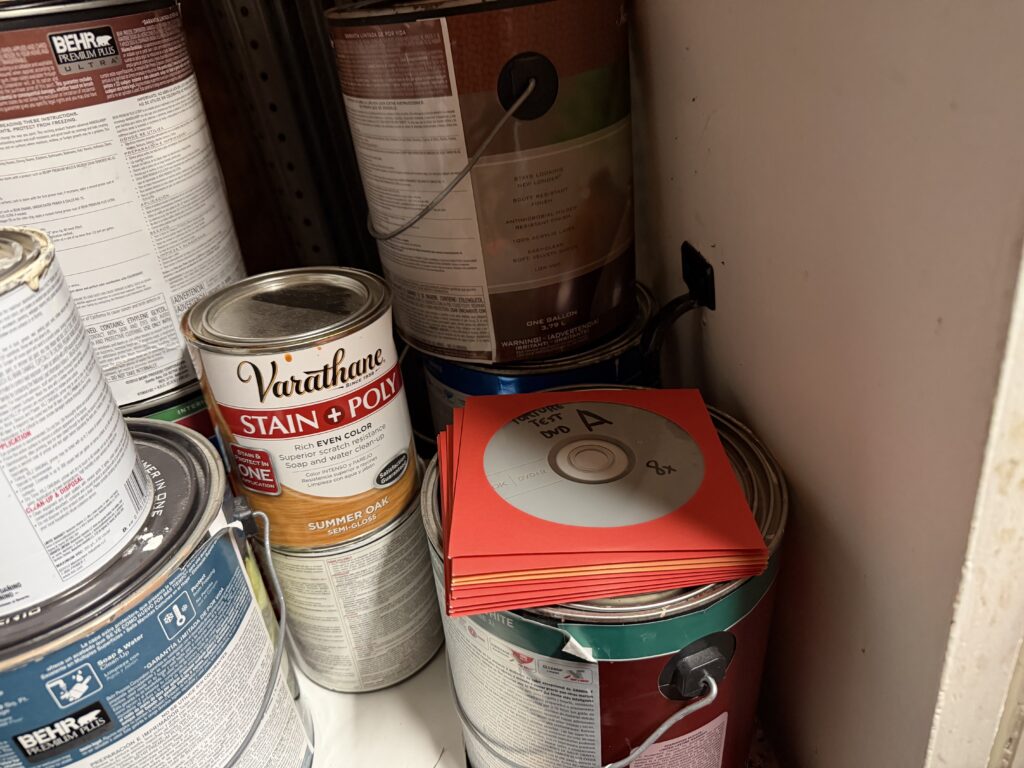
All discs were put in Maxell colored disc sleeves (SKU #CD-401), stacked in a pile, and put in the corner of my shed next the to paint I’ll totally use someday. My shed is not insulated, but it’s dry and UV shielded. I live in a part of the country that regularly sees 95°F weather in the summer with 70%+ humidity, and regularly drops below 15° in the winter, so while not the worst possible conditions, the discs will still be taking a pretty severe beating, likely far worse than any that would be stored inside your average house. I plan to check back every six months until all the discs die or I forget they’re out there, and will be posting the results here on my blog.
| Disc | Reads? | Bad Sectors | Redumper MD5 Hash | |
|---|---|---|---|---|
| Cyanine DVD+R A | Yes | 0% | 2a04f73dea546a15e4726a6f093cf1dd | |
| Cyanine DVD+R B | Yes | 0% | a800943c08997c8c21eb42e00d59d96d | |
| Azo DVD-R A | Yes | 0% | 8ffe1d6510127e6d81c929a7ec704137 | |
| Azo DVD-R B | Yes | 0% | 071cf2349bb5f997b15b0b32e5a2b06c | |
| Warner DVD-R A | Yes | 0% | ec2df1d5fddad019d13fb5106df7ee7f | |
| Warner DVD-R B | Yes | 0% | ec2df1d5fddad019d13fb5106df7ee7f | |
| HTL BD-R A | Yes | 1.95% | f4a1f6c82e52919d4ebdffd03043a4c8 | |
| HTL BD-R B | Yes | 1.95% | 07be249bb71d0e38e896828f7b6c3c0f | |
| LTH BD-R A | Yes | 0% | d8a8fb8f7b47abc2eb78a9ed0c26154e | |
| LTH BD-R B | Yes | 0% | 8dfa426c6ecf0c039bcce90c87f651f0 | |
| Test #1: 2026-08-19 (Day 1), 87ºF, 63% Humidity | ||||
Leave a Reply